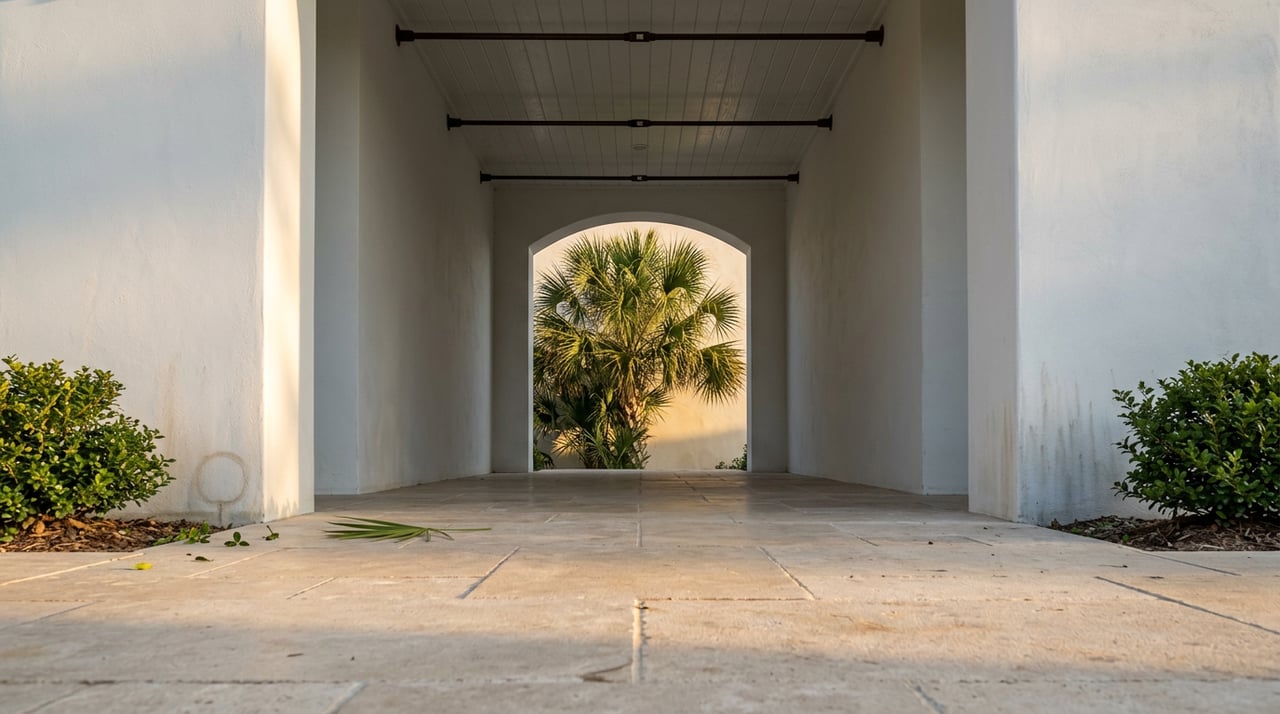
On August 28, 2024, Walton County opened a 136-foot tunnel under Highway 98, giving Inlet Beach a way to cross one of the busiest stretches of road in the Panhandle without waiting for a gap in traffic. Ten murals went up inside, courtesy of the Cultural Arts Alliance of Walton County. The photos circulated. Then, for most of the year that followed, the tunnel mostly just sat there, technically finished and functionally ignored.
That gap between "built" and "used" is the part nobody puts in the ribbon-cutting coverage, and it's the part that actually tells you something about how this neighborhood works.
The underpass cost $5.6 million and took roughly a decade of advocacy to reach construction, a partnership between Scenic Walton, the Florida Department of Transportation, Walton County, and property owners who donated land to make the twelve-foot-wide passage possible. It's only the second pedestrian underpass in the Florida Panhandle, after one at Florida State University in Tallahassee, and the only one on Highway 98. On paper, that's a serious piece of infrastructure. In practice, by early 2026, county engineers and the businesses clustered around it were still waiting for people to actually walk through it. A January report from local news in Walton County described the tunnel getting less foot traffic than hoped, prompting the county to add signage and adjust connecting paths just to get people to notice the thing was there.
The metric nobody was counting
The problem was never capacity. Bryan Corr, the developer behind 30Avenue, put it plainly to Scenic America this August: the highway itself was never what kept people out of 30Avenue's restaurants and shops. What kept them out was a habit. Faced with a four-lane highway, most people just got back in the car, even when the destination was a five-minute walk away.
That's a different problem than the one an underpass, by itself, solves. You can build a safe crossing and still have nobody use it if driving remains the default. Habits don't change on opening day. They change slowly, and usually you don't notice until something downstream of the habit breaks.
By this summer, something downstream broke. Tenants at 30Avenue started asking management for more bike parking, specifically because bikes were piling up in front of their doors. Nobody built that problem on purpose. It's the kind of complaint that only shows up after enough people quietly changed how they get to dinner.
"Inlet Beach ten years ago was a tale of two towns, the North and the South."
— Bryan Corr, quoted by Scenic America
That's Corr's own framing for what the highway used to mean here, and it's a more honest description of the old divide than "traffic was bad." The tunnel didn't erase that split in year one. It took about two years for enough people to test the walk, like it, and repeat it often enough that a restaurant manager finally had to find room for more bike racks.
What the tunnel actually connects
Walk through the underpass today and you land at the edge of 30Avenue's dining row: Cuvee 30A, chef Tim Creehan's fine-dining spot with live music several nights a week, sits alongside AJA 30A for elevated Asian plates, Amici 30A Italian Kitchen, Amigo's 30A Mexican Kitchen, Goatfeathers Seafood Market, Idyll Hound Proper, Canopy Road Cafe, and Marble Slab Creamery for the walk back. On the other end of the tunnel, the Donut Hole and Shades Bar & Grill anchor the older, more residential side of the intersection, the businesses Corr says were already drawing foot traffic across Highway 98 before the underpass existed, just less safely.
The point isn't that any of these were unreachable before 2024. It's that reaching them meant timing a crossing against beach traffic, and enough people decided that wasn't worth it on a Tuesday. Now it doesn't require that calculation. According to Corr, visitors are increasingly choosing to stay on one side of the highway specifically because they can walk or bike to the other side to eat, something that wasn't really a factor in where people booked a stay two years ago.
The murals got the attention. The habit is the actual story.
The ten murals inside the tunnel, each 20 feet wide and 8 feet tall, running the full 136-foot length, were commissioned from local artists Francisco Adaro, Katherine Boggs, Heather Clements, Bradley Copeland, Olga Guy, Wes Hinds, Sarah Page, Andy Saczynski, Andrea Scurto, and Lindsay Tobias. They're worth the detour on their own, and they're the reason the tunnel got photographed more than it got walked, at least at first. Art gets you a photo once. It doesn't get you back every week. What gets you back every week is that the walk to Goatfeathers now takes less time than finding parking would have, and that's a math problem residents solve for themselves after a few tries, not something a mural convinces you of on day one.
What this changes if you live here
If you're on the inland side of 98, the practical shift is that a Cuvee 30A reservation or a Thursday night on 30Avenue's green no longer means parking twice, once for your car and once for a spot in the restaurant's lot. You walk under the highway and you're there. If you're renting or staying south, near the beach, the same logic runs in reverse for reaching the Donut Hole or Shades without adding a car trip to a day that's already full of beach gear and coolers.
The one adjustment worth knowing about before you bike over for dinner: pick a rack early. The same bike traffic that convinced 30Avenue's tenants to ask for more parking hasn't been fully solved yet, and a packed rack in front of Cuvee 30A on a Friday night is now a real possibility rather than a hypothetical one.
None of this required a real estate transaction to notice. It's the kind of shift that shows up first in where people park, not in what anything costs, and it took a full two years past the ribbon-cutting for the neighborhood to actually feel different on the ground. If you've lived through both versions of Inlet Beach, the one where 98 was a wall and the one where it's a walk, that's a useful thing to have watched happen from the inside.
We follow these changes because we live and work here too. If you ever want a read on how a shift like this affects property values or timing on the 30A corridor, that's a conversation for a different day. For now, enjoy the walk. Live Love 30A will be here when you're ready to talk shop.